Tuesday, March 4, 2008

Using Resistance Bands In Stomach Exercises

Using Resistance Bands In Stomach Exercises

Using resistance bands can be an effective component of any workout routine, and stomach exercises are no exception. There are a number of exercises targeting the midsection that incorporate resistance bands. Resistance bands come in a variety of difficulties, usually indicated by the color of the band itself (e.g., green can be little resistance, yellow may be medium, red for difficult, etc.). Choose a resistance level that is appropriate for you, then move up as necessary. Do not overdo it by immediately grabbing the most advanced band you can find, as this can lead to injury. As with any workout routine, be sure to consult a professional before beginning and always warm up properly to avoid injury.

Seated Crunch


This exercise provides the same benefits as the basic abdominal crunch, but with less neck strain and without the possible discomfort that comes with lying on the floor, since it uses a band rather than gravity to provide resistance. For this stomach exercise, you will need to be sitting in a straight back chair which you can somehow loop your band through. Sit up straight with your feet flat on the floor and about as wide apart as your hips. Contract your abdominal muscles, and slowly bend forward to about a forty-five degree angle. Repeat for an entire set. Be sure to keep your feet on the floor and your back as straight as possible.

One-Arm Band Pull


Put the chair away and stand up, again with feet hip width apart. Put your hands above your head, holding the band about eighteen inches apart. Keeping your left hand overhead, bring your right hand out to the side, elbow bent at about a ninety degree angle. Hold your left arm still as you contract your abdominals and lower your right arm until your hand is in line with your chest. Hold this position, then slowly return. Repeat for an entire set, then switch hands. Keep your back straight and avoid bending or leaning at the waist. For an additional challenge, do this exercise standing on one foot. Perform the exercise with both hands while standing on your left foot, then do it all again on your right foot.

Twisting Roll-Back

For this stomach exercise, you will need to sit on a flat surface, preferably the floor. Use a mat or towel for cushioning to ease possible strain on your tail bone. Sit down with your legs bent and heels on the floor. Your toes should be pointing up-- do not put your feet flat on the floor. Loop the band around your feet, put one end in each hand and put your hands together. In a rolling motion, lower your torso toward the floor about forty-five degrees. As you do this, twist to the right and spread your hands to the sides. Hold for a second, then rotate back to the middle and raise your torso back to start. Your heels should remain on the floor throughout the exercise. Do a full set, then switch to the left side.

Tuesday, February 26, 2008

Lose Your Belly by Improving Your Posture

Everyone knows the children's song about the leg bone being connected to the hip bone, but how many people really take it to heart? Obviously, everyone knows that the leg bone does in fact attach to the hip bone; that's not the point. Probably not many people really stop to think about how related and interconnected the parts of the human body really are. In an illustration of this point, the back and stomach muscles are all affected by one another as they form a girdle around the lower torso. It stands to reason, then, that your posture affects how your tummy looks, and the strength of your stomach muscles affects your posture.

Stand Up Straight
This first step to losing a belly is to stand and sit up straight. This actually has a few different effects. First of all, slouching accentuates belly fat, so simply sitting up will make you appear slimmer. Second, proper posture help improves the strength of your back, which of course makes it easier to maintain proper posture longer. Third, poor posture leads to back pain, which makes stomach exercises difficult. Having good posture will make it easier for you to work out your stomach muscles and whittle down that belly. Lastly, a nice straight posture enhances blood flow throughout the body, particularly to the legs and lower back, both of which are involved in many stomach exercises. So, if you are trying to lose a belly, the first step is to simply sit and stand up as straight as possible as often as possible. Do that, and you are already on your way!

Back Extension
For the reader familiar with the crunchless crunch, this move will seem similar but backwards. For this exercise, you will need to start by lying on your stomach with your forehead on the floor. You may use a mat or towel to cushion your pelvis and head. Position your arms by your sides, palms up. Contract your back muscles to lift your torso off the floor. Hold the contraction briefly, then release and slowly lower your torso back down to the floor. Repeat for an entire set.

The next part of this exercise begins by extended your arms out above your head (picture a superhero flying through the air). Now lift your legs off the floor simultaneously while keeping your head and arms held in place. Try to imagine your legs growing longer as you are lifting them up. Hold your legs up briefly, then slowly lower them back to the floor.

Doing these two things will help you strengthen your back and correct your posture, which are great first steps to losing an unwanted belly. You will also want to continue working on your back muscles and other core muscles, such as the transverse and rectus abdominus. Stomach exercises that work the core will help you straighten up your posture, lose belly fat, and gain muscle tone in both your back and tummy. As with any workout routine, be sure to consult a professional before beginning and always warm up properly to avoid injury.

Saturday, February 16, 2008

All About Working The Transverse Abdominals

A group of muscles that often gets neglected in stomach exercise routines are the transverse abdominals, the core muscles that lie below the rectus abdominus. Most abdominal exercises target the rectus abdominus and the vertical abdominals, ignoring the transverse abdominals. Even crunches, the staple of most abdominal workouts, do nothing for the transverse abdominals. These muscles are actually the most important to target, however, as they connect to both the lower back muscles and the rectus abdominus and for a girdle for the entire abdomen. Any routine aimed at flattening the stomach should include the transverse abdominals as a focus. Using the following exercises, you can work out your transverse abdominals and really make progress on that flat tummy. As with any workout routine, be sure to consult a professional before beginning and always warm up properly to avoid injury.


Pelvic Tilts
This stomach exercise requires lying on your back on a flat surface, such as the floor or a bench. Use a mat or towel to cushion your spine. Bend your knees so that your feet are flat on the floor. Raise your pelvis (and only your pelvis) off the floor, hold momentarily, and then lower it back down. Repeat for an entire set. Maintaining a controlled movement is crucial to this exercise. This will allow you to use your abdominal muscles, rather than your body's momentum, to do the work on the exercise. Also, be sure to keep your upper body on the floor throughout.

Crunchless Crunch
This first exercise is fairly simple but can also be fairly difficult. Essentially, it involves trying to pull the belly button in towards the spine. This can be tricky, as it involves using muscles which you may not be used to activating. To start, either lie or on your stomach or kneel. You might want to try both ways and see which helps you feel the exercise better. Relax your body as much as possible, then try to use only the lower abdominals to move your belly button toward your spine. Hold for ten seconds. If holding for ten seconds feels easy, hold for a longer period. The goal is to hold the contraction until you either cannot feel it, or you feel other muscles working harder than the transverse abdominus. When you feel this, let the contraction out.


Scissor Kicks
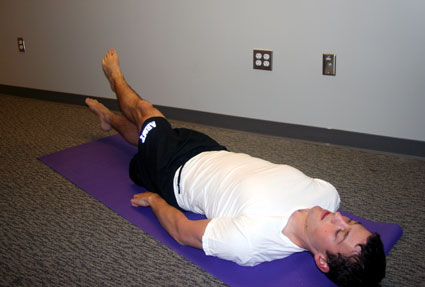
This stomach exercise also requires lying on the floor. Position your hands under your butt, keeping your back pressed against the floor. Slowly raise one leg to a height of about ten inches, then slowly lower it back to the floor. As your lower one leg, raise the other. Repeat this motion for an entire set. Maintaining control throughout is important, not allowing momentum to get the better of you. Your upper body should remain on the floor through the entire move.

There are plenty of other exercises targeting the transverse abdominals, but these three ought to be enough to get you started. Stomach exercises like these are key to any tummy-flattening plan, and they are especially good for pregnant and post-partum women.

Monday, February 11, 2008

Shrink Your Tummy!

The midsection is a problem area for many people, and those who want to shrink the size of their belly are numerous. A balanced diet is a good place to start, but there are also some great stomach exercises to help along the process. The exercises discussed below meet this description, as they are specifically designed to help reduce belly fat, and therefore, the size of your tummy. These particular exercises are targeted at beginners, so give them a try if you are just starting out. Once you have mastered these, feel free to advance to something more challenging. When doing these exercises, it is important to move slowly so as to maintain control and not allow momentum to take over. As with any workout routine, be sure to consult a professional before beginning and always warm up properly to avoid injury.


Vertical Leg Crunch
This is a variation on the traditional crunch that focuses more specifically on reducing stomach fat. To begin this stomach exercise, first lie on your back on a flat surface, such as the floor. Use a mat or towel to cushion your spine. Put your hands behind your head, with elbows out far enough that they are out of sight. Now lift your legs straight up into the air, crossing your ankles and bending your knees slightly. Contract your abdominals and lift your shoulders, head and upper back up to about a thirty degree angle. Be aware of not lifting with your hands or leading with your head.


Long Arm Crunch
For this stomach exercise, remain on the floor with your knees bent and feet flat. Lie back and extend your arms straight back on the floor as though you are reaching above your head. Contract your abs and slowly lift your arms, head and shoulders off the floor to about a thirty degree angle. Hold it, then slowly lower your shoulders back to the floor. Repeat for an entire set. Be careful not to lead with your arms, keeping them straight and alongside your head.


Reverse Crunch
You will need to stay on your back for this stomach exercise. Use a mat or towel to cushion your spine. Put your arms at your sides with palms facing up to the ceiling. Put your legs in the air so that your knees are bent at ninety degree angles and your hips make about a ninety degree angle with your torso. Keep your knees unbent and as straight as possible. Now, contract your ab muscles so that it feels like your belly button is being pulled toward your spine, while at the same time gently lifting your hips off the floor. Raise your hips to height of a few inches, keeping your legs extended straight upward. Hold this position, then slowly lower your hips back to the floor. Repeat for an entire set.

Monday, February 4, 2008

How To Target Your Stomach With Yoga

Yoga is a great part of any wellness routine, as it has the ability to both reduce stress and exercise the body. If you are trying to use yoga to target your midsection, well, that can be done. There are a number of yoga positions (called asanas) which exercise the stomach muscles. Bear in mind that some of these are more advanced than other. Assess your own skill and comfort level before trying certain asanas. If you are not sure you are able to do one asana, start with one that seems easier and work your way up once you have belt some strength and flexibility. As with any workout routine, be sure to consult a professional before beginning and always warm up properly to avoid injury.


Pavan-Muktasan
To perform this stomach-exercising asana, first lie flat on your back. Use a yoga mat of towel to cushion the spine. Bend both knees up to your chest so that your thigh touches the stomach. Hug your knees in place and lock your fingers. Now lift your head up so your nose meets your knees. Take a deep breath and hold it for thirty seconds before releasing and slowly lowering back to start. This exercise can also be done one leg at a time.


Bhujangasan
For this stomach exercise, remain on the floor, but roll over on to your stomach. Position your hand under your shoulders. Now, using your back muscles, raise your upper torso off the ground to that your head is upright. Be careful not to push with your hands. You want the muscles in your back to be doing the work. Hold this posture for thirty seconds, then lower yourself back to start. Even though you are using your back muscles to lift your upper body, performing the asana will assist in reducing belly fat and flattening your tummy.


The Bow
This stomach exercise is pretty similar to the previous asana, but more involved. It starts from the same position lying on your stomach, but in this exercise you curl your legs upward in addition to lifting your upper torso. Bend your knees so that the soles of your feet come up toward your head. Grab your ankles and pull with your hands and push with your legs until only your stomach is on the floor. Your body should feel sort of like it is making a circle. Your knees should remain together throughout the exercise. Hold this position for thirty seconds before releasing and returning to starting position.


Paad-Pashchimottanasan
Now that you have read the name of this asana, try not to be intimidated-- it is less complicated in practice than in pronunciation. It does, however, require a fair amount of flexibility, so you may want to start with something easier and build up to this one. Start by lying on your back with your legs straight and arms overhead. Your body should be straight from head to toe with all limbs extended. Point your palms up to the ceiling and put your hands together. Contract your stomach muscles to sit up, keeping your back straight and hands overhead. Bend forward and grab your toes with your hands, putting your head between your arms so it touches your knees. Hold the position for two minutes before releasing.

Thursday, January 31, 2008

The Post-Partum Tummy Routine

Having a baby is a beautiful and exciting thing. What is less beautiful and exciting, however, is the extra weight that hangs around the midsection after the baby has been born. The best way to go about shedding this baby belly is proper diet and an exercise routine, which may not always be easy to do for a new stay-at-home mom still reeling from a pregnancy. The good news is that working out and eliminating the extra belly fat will give you more energy, so you can spend more quality time playing with and caring for your new rugrat. Here are a few simple exercises to set your on your way toward baby belly freedom. As with any workout routine, be sure to consult a professional before beginning and always warm up properly to avoid injury.

Progressive Crunchless Crunch
This stomach exercise works your abdominals as well as a crunch does, but without the strain to your neck and back. Begin by sitting in a chair, placing one hand above and below your belly button in order to feel the contraction of your abdominals. Take one big deep breath, so your midsection expands completely. Then let the breath out as you pull your belly in, imagining your belly button being pulled inward toward your spine. Finally, briefly contract your abs five times. Do a full set of repetitions of all three parts. You can also try this exercise lying on your back. Try both to see which one helps you feel the contractions of your abdominal muscles better.

Contractions
This exercise starts off very much the same way as the last one, but involves quicker steps and more repetitions. Begin by sitting in the same position as in the progressive crunchless crunch, and taking the same deep breath. This time, instead of bringing your belly all the way back, exhale and bring it just about halfway. Then pull your belly button back toward your spine. Contract and hold for a count of one. Repeat from the half-exhalation point. Do the whole thing one hundred times.

Crunchless Crunch
As you can tell from the name, this stomach exercise is very similar to the first. Instead of making a few stops as you exhale a deep breath, however, this exercise consists of just one move. To start, either lie or on your stomach or kneel. You might want to try both ways and see which helps you feel the exercise better. Relax your body as much as possible, then try to use only the lower abdominals to move your belly button toward your spine. Hold for ten seconds. If holding for ten seconds feels easy, hold for a longer period. The goal is to hold the contraction until you either cannot feel it, or you feel other muscles working harder than the transverse abdominus. When you feel this, let the contraction out.

If you start doing these stomach exercises at home in your spare few (very few) minutes, you can lose your baby belly and be fit and trim and just a few months-- just in time to start chasing after Junior once he learns to crawl!

Tuesday, January 29, 2008

The Strong Stomach Workout

When beginning an abdominal workout routine, for most people the goal is simple: a flatter stomach. While a smooth, flat stomach looks good, it is less of an accomplishment if the the stomach muscles have not gained any strength. In addition to slimming down around the outer abdominals, it is also important to build strength in the core abdominals. Below are some stomach exercises that work out the core to build strong muscles throughout the abdomen. As with any workout routine, be sure to consult a professional before beginning and always warm up properly to avoid injury.

Tone Your Torso
Begin this stomach exercise on all fours, knees and hands on the floor. Keep your stomach pulled in and extend your left arm out in front of you (football fans, imagine a referee signaling first down). Keep this arm outstretched as you extend your right leg out behind you. Switch arms and legs, and repeat for an entire set. Take particular care not to let your pelvis sway out of position.

Butt Burner
You will need to lie on your back for this exercise. Use a mat or towel to cushion your spine. Bend your knees so your feet are flat on the floor, and position your arms at your sides. Squeeze your buttocks as you lift your pelvis off the floor. Keep the rest of your body in line. Raise your pelvis to about forty-five degrees, so your upper body from your head to your knees makes a straight, flat ramp. Hold this for three to five seconds before slowly lowering your pelvis back to the floor. Repeat for an entire set.

Crunchless Crunch
This stomach exercise is fairly simple in theory but can be fairly difficult to perform. Essentially, it involves trying to pull the belly button in towards the spine. This can be tricky, as it involves using muscles which you may not be used to activating. To start, either lie or on your stomach or kneel. You might want to try both ways and see which helps you feel the exercise better. Relax your body as much as possible, then try to use only the lower abdominals to move your belly button toward your spine. Hold for ten seconds. If this feels easy, hold for a longer period. The goal is to hold the contraction until you either cannot feel it, or you feel other muscles working harder than the transverse abdominus. When you feel this, let the contraction out.

Scissor Kicks
This stomach exercise also requires lying on the floor. Position your hands under your butt, keeping your back pressed against the floor. Slowly raise one leg to a height of about ten inches, then slowly lower it back to the floor. As your lower one leg, raise the other. Repeat this motion for an entire set. Maintaining control throughout is important, not allowing momentum to get the better of you. Your upper body should remain on the floor through the entire move.

These are just a few of all the strength building stomach exercises out there. If you are looking to build strength in your midsection, look for any exercise that works your core, especially the transverse abdominal muscles. Many components of Pilates are good for this also.

Monday, January 28, 2008

4 Things That Always Come Before A 6 Pack Abs

Sometimes all it takes to get caught up in the hype of the latest ab machine or miracle pill is a simple photograph of a stunning set of 6-pack abs. Just about everyone wants six pack abs, or at least a trim waistline, if not a muscular one, so all the glory these days has gone to exercising the abdominal muscles. But this has caused some serious problems, and falling for the latest gimmick is not the least of them.

When you become so focused on abs and abdominal exercises, you tend to completely forget that there's much more to seeing your abs than doing crunches and other exercises for the rectus abdominis. By focusing only on the 6-pack muscles, not only do you fail to learn about the complexity and importance of the entire core region and the deeper muscles that aren't so "glamorous," you also tend to completely forget the other things that absolutely must come before 6-pack abs ever arrive.

If you fail to do these other 4 things first, it doesn't matter how much abdominal exercise you do, you will never see a six pack.

To See A set of Six Pack Abs, First, Your Body Fat Must Be Low enough

The biggest reason most people can't see their abs is because most of the population is overweight or even obese today. For your abdominals to show through, you need a low enough body fat percentage.

For men to see a clearly defined set of six pack abs, it usually requires getting down to about 10% body fat or less, and for the women, it's usually about 16% body fat or less. It's not possible to tell you exactly what body fat you will have to reach to see your abs because it also depends on your individual genetics. For example, one man can see a six pack at 11% body fat, while other men say they don't see their abs until they're 7% or 8% body fat.

Reduction of body fat is the first and most important thing that must come before a 6-pack. And that leads you to the question, "what is the best way to reduce body fat?"

The first priority in reducing body fat is nutrition, because the easiest way to create a caloric deficit is with a reduction in food intake, but few people think about the quality of the food they're eating, only the quantity. Proper hydration is also critical, but often forgotten. Exercise is the final key, but ab and core exercises alone just won't do it. It takes a certain combination of exercise for optimal results.

The Other 3 Things That Come Before A 6-Pack

1. Eat Organic I preach organic so often that to my regular readers, I probably sound like a broken record. However, it's not without reason: if you want your liver to process body fat efficiently, then you'd better have this important organ working efficiently and kept in good health. Refined foods and alcohol harm the liver and give it no chance to process body fat the way it was designed to do because it's too busy dealing with all the toxins you've consumed. So eat as organic as your budget will allow. If you can't afford organic, be sure to wash all of your food items (produce) with a natural food cleaner. Eating organic, fibrous foods will also increase improve the functioning of your digestive system and create for regular movements. You should have a bowel movement 2-3 times per day. If not, you are putting a lot of unnecessary stress on your digestive system. If this happens, then losing fat and keeping it off becomes much more difficult.

2. Drink and Be Hydrated! I urge every one of my clients and readers to drink more water. Many people understand the importance of avoiding dehydration, but they don't realize how important water is in helping remove fat from the body. Most of us are dehydrated and do not even know it. Here's a simple hydration test – pinch the skin on the back of your hand. Pull is up as high as it can go, then let it go. Does it go back to normal immediately? If not, then you're dehydrated. The rule of thumb is to drink a minimum of a half an ounce of water for every pound of body weight. So if you weigh 200 lbs, you drink at least 100 ounces (Also, if possible, avoid tap water or plastic bottled water as plastic contributes to estrogen and that encourages stubborn fat)

3. Exercise right! If you give body fat a reason to "hang around" (pun intended), then it will. Give body fat a reason to leave and it will do that just as easily. Some kind of activity every single day is just what the doctor ordered for fat loss. Rather than focusing on one type of exercise like bodybuilding or aerobics or yoga or pilates, or just strength or flexibility, I recommend a combination of cardio training, strength training and specific core conditioning exercises. While I recommend exercise such as walking very highly, I also recommend at least some vigorous and intense exercise such as interval training as well. It's this combination of strength and cardio training, plus an active lifestyle in general, that will help you reduce your body fat enough for your abs will show.

Before you jump the gun and go ballistic with "abdominal exercises," remember, that there is more to seeing your abs than just crunches. Seeing "6 pack abs" is first a function of low body fat. Achieving low body fat is in turn a function of what you eat, what you drink and how you move. That makes 4 things that come before a 6-pack. You can "ab roller" and "crunch" until the cows come home, but if you haven't done these four things first, then you're approaching it backwards and will be disappointed

Article Source

Thursday, January 24, 2008

Where To Find Free Exercises To Flatten Stomach

They are everywhere; magazines where on the front cover have beautiful models showing off their flat stomach and a caption that may say something similar to "Want flat abs, we'll show you how!" These magazine articles are great for some people who want to spend the money to buy the magazine in order to find out how to flatten their stomach. Then there are endless websites that if you sign up and pay the fee, you will be given exercise routines meant to flatten you stomach. Again, this may be a good source for some people who have this goal, but where can you go to find free exercise to flatten stomachs?

The internet is probably one of the best sources for finding free information. There are hundreds of sites a person will find just by using the search words "free stomach exercises" or similar phrases. These sites will give step-by-step instructions on how to perform a variety of exercises to flatten stomachs. When a person finds several exercises he or she likes, it is simple to print them out and have the paper available when performing the exercise.

Another good source to find free exercises to flatten stomachs is at a library. The library may actually have more information then the internet; it is just not as convenient. A person who takes the time to visit the library can find books on how to flatten their stomach read magazine articles and borrow videos that talk about exercises to flatten stomachs.

One source for finding free exercise to flatten stomachs is the television. If a person can set aside a specific time during the day for exercise, there are many television programs on throughout the day that are exercise related, even channels dedicated just to exercise and health. Many of these shows will focus on flattening stomachs, since this is a primary goal of most people that exercise. This method for finding free exercises to flatten stomachs may be the least convenient and may not be feasible to everyone, but for some people that can find the right program and make it work with their schedule or the ability to record for use at a later time, it may be a good option.

For people that truly need to loose weight around their stomachs for health reasons, doctors are probably the best source for free exercises to flatten stomachs. They will have available many brochures and other material that will help the person in their goal to look and feel better. In addition, a doctor would be a good source for finding out other places to obtain this information.

There are hundreds of sources for finding exercises to flatten stomachs. Some of these sources require a purchase or even an investment. There are also many sources available that offer free exercises to flatten stomach muscles. Just because a person paid for the information does not necessarily make it better. Remember, the best exercise is the exercise that works for the individual, regardless of the source.

Sunday, January 20, 2008

Six Poor Stomach Exercise Habits

As with all things, there is a right way to go about working for a flatter midsection, and several wrong ways. Working out the wrong way can lead to no physical improvement or worse, serious injury. When doing stomach exercises or any other exercise, be sure to consult a professional, warm up properly, and remember the following tips.

Keep Your Knees Up
When doing crunches, you want your knees to bent and your feet flat on the floor so that your knees are centered and pointed upward. Keep them centered and up, not to one side. If you drop your knees to one side, you are unnecessarily compressing your vertebrae, which can lead to a painful back injury.

Sit-Ups
Traditional sit-ups actually do very little for the abdominal muscles. Even when done properly, the strain is mostly on the hip muscles. There is also the tendency to pull the torso up with the arms, which of course is not the point of the exercise. Further, when sit-ups are done very quickly, as people have a tendency to do, it is momentum that mostly forces the torso up and down, rather than any muscle groups. The crunch is a good alternative to old school sit-ups.

Straight Leg Lift
Another traditional "stomach exercise," this move actually works the lower back more than any muscles in the midsection. This is also another way to put strain on your back, possibly leading to injury.

Too Many Reps
There is never a need to do more fifty reps of a stomach exercise. If fifty reps is not giving you results, doing more than that will not help wither. As you build strength, if you feel the need for a bigger challenge, try a more difficult exercise as an alternative to adding reps.

Sleeping
Believe it or not, how you sleep has an effect on your stomach exercise routine. If you sleep in a position that cause back pain, it will make it much more difficult to work on your midsection in the morning. Sleeping mostly on your stomach is one of the best ways to cause back pain, as it forces your back to arch, often resulting in annoying back pain. The best way to avoid this is to sleep on your back with a pillow under your knees. This will help keep your vertebrae in line, prevent back pain and allowing you work out pain free in the morning.

No Resistance
All stomach exercises need resistance to be effective, whether it comes from a resistance band, an exercise ball, or just gravity. Exercises that do not use any resistance, such as standing broomstick twists, will not be beneficial to your midsection. The good news is that this particular exercise will not do any harm and is actually a good warm up for your trunk. Just do not expect it to flatten out your stomach.

Proper exercise technique is important. These are just a few tips to help you avoid wasting time and potential injury. Be sure to research thoroughly before beginning a new exercise, and always consult your physician before beginning any physical fitness routine.

Saturday, January 19, 2008

The Stomach Exercise All-Stars

There are plenty of stomach exercises out the for those who want to shape their core and strengthen their midsection. This may be both a blessing and a curse. It is easy to find plenty of exercises and routines that work the midsection, but how does one know which ones are any good? Well, listed here are what appear to be some of the best around, according to recommendations by fitness experts. If you want to work on your stomach, but are not sure where to start, then this "all-star team" may be a good jumping off point. As with any workout routine, be sure to consult a professional before beginning and always warm up properly to avoid injury.

Crunchless Crunch
Regular crunches are great for working the rectus abdominus (the muscles at the front of your stomach), but they do very little for the transverse abdominal muscles deeper in the midsection, plus they tend to put strain on your back and neck. This first exercise corrects that, working the transverse muscles with no back or neck strain. Essentially, it involves trying to pull the belly button in towards the spine. This can be tricky, as it involves using muscles which you may not be used to activating. To start, either lie or on your stomach or kneel. You might want to try both ways and see which helps you feel the exercise better. Relax your body as much as possible, then try to use only the lower abdominals to move your belly button toward your spine. Hold for ten seconds. If holding for ten seconds feels easy, hold for a longer period. The goal is to hold the contraction until you either cannot feel it, or you feel other muscles working harder than the transverse abdominus. When you feel this, let the contraction out.


Hip Lift
Remain on your back for this stomach exercise. Put your arms at your sides with palms facing up to the ceiling. Put your legs straight up in the air so that the soles of your feet are facing the ceiling and your legs make about a ninety degree angle with your torso. Keep your knees unbent and as straight as possible. Now, contract your ab muscles so that it feels like your belly button is being pulled toward your spine, while at the same time gently lifting your hips off the floor. Raise your hips to height of a few inches, keeping your legs extended straight upward. Hold this position, then slowly lower your hips back to the floor. Repeat for an entire set.


Long Arm Crunch
For this stomach exercise, remain on the floor with your knees bent and feet flat. Lie back and extend your arms straight back on the floor as though you are reaching above your head. Contract your abs and slowly lift your arms, head and shoulders off the floor to about a thirty degree angle. Hold it, then slowly lower your shoulders back to the floor. Repeat for an entire set. Be careful not to lead with your arms, keeping them straight and alongside your head.

Some other honorable mentions include the vertical leg crunch, torso twists, and any Pilates routine that emphasizes the core. Feel free to research some of these exercises more once you have mastered the three above. Now that you are armed with some of the better stomach exercises, you are on your way to a trimmer tummy!

Friday, January 18, 2008

Aquasize To A Flatter Stomach!


When the weather is warm, there is nothing quite like going for a refreshing swim at the local pool. To add to the benefits, you can use it as an opportunity to work on those stomach muscles. The water provides natural resistance, making the pool a great place to do stomach exercises to flatten out that tummy. Despite the greater resistance water has than air, aquasizing is low-impact, meaning less strain on joints. Try out these exercises next time you take a trip down to your pool. Remember, consult your doctor before beginning a new workout routine, and always warm up properly to prevent injury.

The first set of exercises to try is called the jump and dig. There are two moves in this set, one for the upper body and one for the lower body. The former is great for your obliques, and the latter works on your abdominals. To start, stand in water that is between your belly button and chest. To work the lower body (including your abdominals), put your feet a wide distance apart, then jump so your knees come up to the surface of the water and back down. Picture a frog as you do it; this will help you get the form right. Next, to work the upper body, begin by making a scoop with both hands at the surface of the water. Bring your hand scoop below the surface, then scoop up and to one side. Alternate sides to work the obliques on both sides. Start by doing the two moves separately for three minutes each. Once you have mastered the form, do them at the same time to exercise both sets of stomach muscles at once.

As you build strength and endurance, you can add water gloves to increase resistance. You can also do the exercises faster, packing more reps into each three minute period. Form is key, though. Do not sacrifice form for the sake of speed. It is better to do it properly than quickly. Also remember to set fitness goals and work toward them at a gradual pace. Do not push yourself too hard, too fast. You may want to see results fast, but an injury will seriously delay your workout goals. Start small, know your limits, and build gradually.

As long as you are working on your midsection, here are a few additional tips. First, proper diet is essential to any fitness routine. A great, hard workout can be completely negated by improper eating habits. Second, stay hydrated both while working out and in everyday life. A good rule of thumb is to take your body weight in pounds, divide it by 2, and drink that number of ounces of water each day. This helps to keep the body functioning at it's highest level. Third, rest up. This means not only getting plenty of sleep, but also getting the right kind of sleep. Spend all night sleeping on your stomach, and you will wake up with a sore back, making it difficult to do your stomach exercises. Also be sure to schedule off days into your routine to give your muscles a chance to rest up and rebuild. Now you already have a great start on a toned, flat stomach!

Wednesday, January 16, 2008

All About The Best Stomach Exercises

It is only natural, most people want to look their best, and exercising their stomach muscles is usually a huge part of most fitness programs. If so much time and energy is going to be focused on this muscle group, it is a good idea to know what the best stomach exercises are. There are many resources available for finding the best stomach exercises, and plenty of people to say what they consider the best, so how can a person decide for themselves which truly are the best exercises for working their stomach muscles?

First of all it is important to note that the best stomach exercises are those that a person is willing to do. No matter how effective the exercise is, if a person isn't going to do them consistently the exercise will not benefit that particular individual. It is also important to note that the best stomach exercises do not necessarily require equipment to perform them, although some machines and equipment may work quite well for some people.

When a person decides on a fitness program that includes stomach exercises, it is best to include stomach exercises that work the different parts of the stomach. If a person simply concentrates on one area of their stomach, there workout will not be as effective. The best stomach exercises, combine working the oblique, which are the side muscles, the lower abdominals, the mid section and also the upper section.

Some of the most popular stomach exercises are crunches. These are a very effective exercise and very convenient since they can be performed anywhere without any equipment. The next stomach exercise that is also very popular and goes along with the basic crunch is the side crunch, which works out the oblique.

Some people consider the best stomach exercises to be included in a Pilate's workout. The reason for this is because in Pilates, the whole focus is on the core of the body which is the abdominal, or stomach muscles. Every movement in a Pilate's workout will work the stomach muscles either directly or indirectly. These exercises can be found on the internet, either the exercise itself or video's that can be purchased.

Another good exercise that some fitness experts considers to be one of the best stomach exercises involves laying flat on your stomach, leg straight and then raising your body up using your arms as your hands are clasped together and keeping your body straight as if doing a pushup. Hold this position as long as you can stand. This is an excellent movement to strengthen the whole stomach.

Remember again though that just because one person may consider a specific exercise to be the best stomach exercise that does not necessarily mean it is the best for everyone. Each person's body is different and will respond differently to certain movements. Any one serious about working on the abdominal muscles will find it most helpful to try several different stomach exercises and then determine which one they can both feel and see results with. If one exercise is simply too hard to do correctly, or does not feel like it has done anything for the muscle group worked, that exercise is clearly not the best and the person should find what works best for them.

Sunday, January 6, 2008

Abdominal Exercises [flatten your abs]

There are literally hundreds of exercises you can do flatten your abs. The exercises selected should be dependent on your current physical ability, awareness, and condition. Out of all of the different muscle groups, abdominals have the biggest variety of exercises to choose from for good reasons. Its main function is to protect the body organs, spine, and pelvis and allow people to function at a higher level in their everyday life and getting better looking athletic physique.

I suggest you discuss beginning an abdominal exercise program with your physician or healthcare professional. Each exercise listed in this section has a purpose and develops muscular function throughout the entire body. Each exercise consists of photographs suggesting the proper form of an exercise, plus a written description of how the exercise to be done. Please read the entire description. Do not rely on the photographs alone.

When you are exercising at home, make sure that you can concentrate on what you're doing.When you look at the photos and try to emulate the exercises being depicted, attend to theform of the exercise being demonstrated, not the demonstrators performance of the exercise. If you cannot carry out an exercise with proper form, stop at that point.

4 Point Transverses Abdominis Vacuum


This exercise is great for isolating the transverse abdominal and reconnecting with the nervous system. To correctly accomplish the exercise get on all fours as though you were in a crawling position. Have your hands directly underneath your shoulders and your knees directly underneath your hips. With good neutral posture position (using a dowel rod placed on your back aligning the spine can provide good feedback of proper neutral posture) make sure the back of your head, thoracic spine (upper back) and sacrum (butt bone) are in contact with the rod. The lumbar spine should be arched just enough to slide the palm of your hand between your back and the dowel rode. Your primary objective is to inhale and allow the transverse abdominis to hang out towards the floor, on exhalation drawn the bellybutton towards the spine. Avoid any spinal movement during this exercise such as contracting the gluteus, hamstrings or external rotators.

Horse Stance Vertical


The first part of the horse stance series is Horse Stance Vertical, which will integrate the spine stabilizer muscles of your spinal column with the other muscles of the inner unit (inner unit will be explained in the next chapter). To accomplish this exercise again get on all fours with your hands directly underneath your shoulders with your elbow slightly bent. Your knees should be directly underneath your hips at a 90-degree Angle.

The exercise is then performed by raising your left hand and right knee approximately one cm off the ground (about the height of the piece of paper). Hold this position for 10 seconds and repeat with the right hand and left knee. Alternate back and forth until you have done the exercise for a total of two minutes. Make sure to not allow the hamstring to flex the lower legs toward the ceiling and that the pelvis does not load (shift) into the hip that is in contact with the ground. To assist you in this exercise use a kitchen timer and set it for two minutes.

Friday, January 4, 2008

Wrong concepts, opinions, rumors, and theories to flatten your Abs - Part 2

1. Fat-Burn Supplements Will Tone My Abs.

Fat burning supplements sure sound good but in my experience they cause more harm than good. Fat burning supplements do nothing to tone or strength your abdominal region. EAT RIGHT.

2. You Can Eat Foods Such As Cookies, Candy, and Cheese as Long as They're Fat-free Versions.


The country it seems is on a fat free kick. Have you ever looked at the labels of fat-free foods? There is the word sugar and more sugar. When sugar is ingested into the body it secretes the hormone insulin. This hormone tries to regulate the blood sugar in the bloodstream. Just remember insulin is a fat-producing hormone. In addition to the massive amounts of refined sugar in these products, they also contain hydrogenated fats.

3. To Have Defined Abs, You Need to Keep Your Caloric Intake to No More Than 1,200 Calories Per Day.


For the general rule is for Women to take in 1500 calories and men 2500 calories. Going below these marks sends your body into starvation mode. Starvation mode will conserve energy by slowing down your metabolism, hence destroying everything you are working to achieve. Therefore, eat!

4. You Should Count Calories.


If you are anal about your caloric intake, count them. However, most of us can get by greatly without measuring a single calorie.

Subscribe via email

Enter your email address:

Delivered by FeedBurner